
AI & Automation | Ask the Archive
Ask your project archive a question. Get a cited answer in seconds.
Years of drawings, RFIs, contracts, and correspondence, searchable in plain English. Ask the Archive reads your firm's own files and answers with the exact passage and a link to the source, on your own network, behind your own permissions.
The technology behind this is called retrieval-augmented generation (RAG). You do not need to know that to use it.
See it answer a real question
This is what your team would actually type
No new search syntax, no new app to learn. Ask the way you would ask a colleague.
› Which projects had curtain-wall water-vapor issues, and how were they resolved?
Returns the past projects, the specific RFIs and change orders involved, and links to the resolved details, every claim cited to its source file.
› Draft an RFI response in our usual voice, based on how we have answered similar ones.
Produces a first draft built from your firm's own past language and formatting. Your team reviews, edits, and sends. The assistant never hits send.
› Pull the change-order language from the hospital project that covered phased occupancy.
Surfaces the clause, the project it came from, and adjacent language from similar contracts, ready to adapt, not rewrite.
› Summarize every outstanding item from the last 90 days of correspondence on this project.
A dated, cited summary, so a new team member ramps up in an afternoon instead of a week.
Catch problems before they cost you
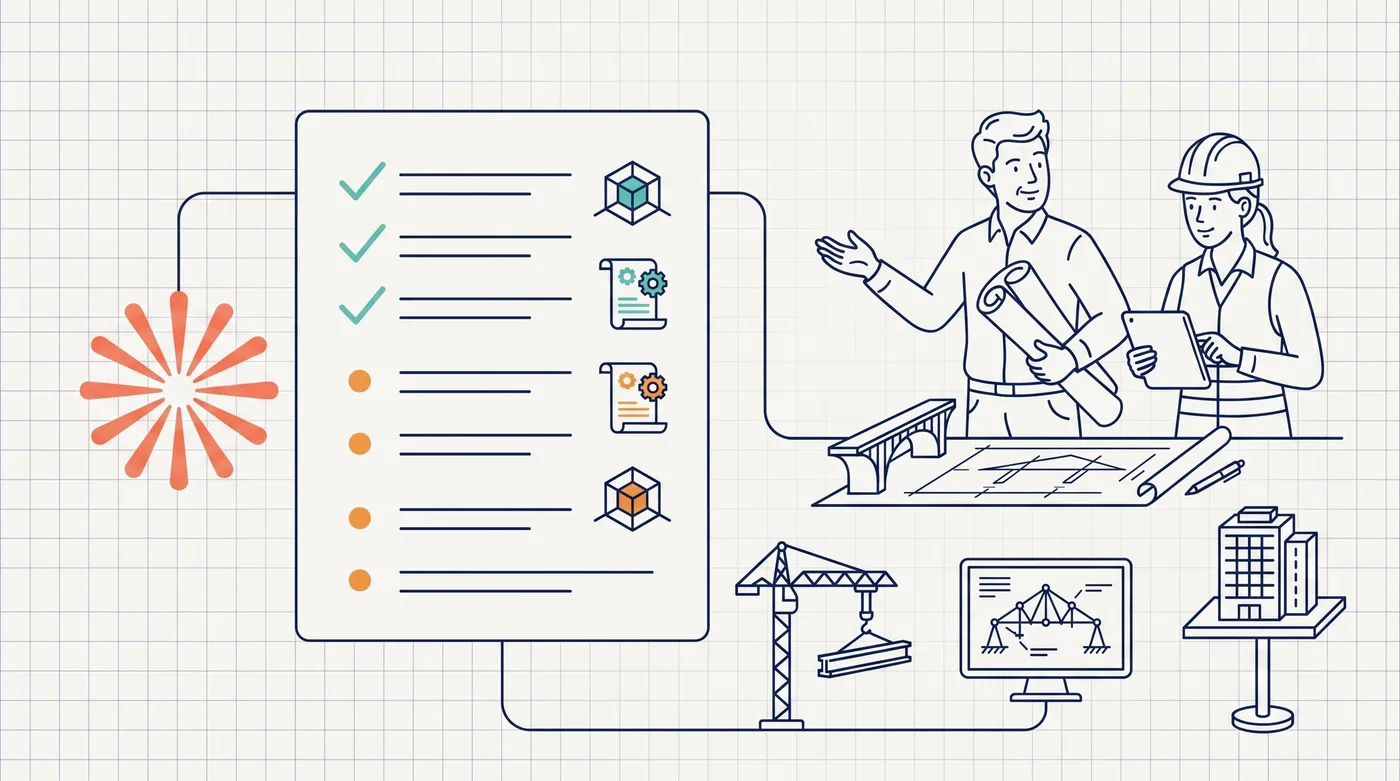
Beyond search, Ask the Archive runs consistency checks across thousands of documents, flagging open RFIs, stale code references, drawing cross-reference mismatches, and unresolved TBD markers, before they turn into contractual problems.
By Design
Same question, different answer
Ask the Archive answers behind your firm's existing permissions. A junior designer and a partner can ask the identical question and get different answers, because the assistant respects exactly what each person is already allowed to open. You connect it to your identity provider once, and financial and HR data stay walled off automatically.
The financial tier
Ask "what is the margin on the hospital project?" and a partner gets a cited number, while everyone else simply does not, with no awkward conversation. The assistant can never show anyone a file they could not already open themselves.
The Problem It Solves
File servers store your knowledge. They are terrible at giving it back.
Three ways that costs you.
Tribal knowledge walks out the door
When a senior person leaves, the memory of where the good detail lives, the right clause, and the subcontractor who flagged an issue five years ago, leaves with them.
The same work gets done twice
Teams rewrite specs, scopes, and contract clauses that already exist somewhere on the server, because nobody has time to go find them, so the clock starts from scratch.
Consumer AI is a data leak
Pointing a personal ChatGPT or Claude account at client files is easy and dangerous. That data lands on public servers, outside your control and your liability policy.
Succession
A retiring principal takes thirty years of answers with them.
A generation of founders is heading toward retirement, and the client history and design decisions of thirty years often live in one head, undocumented. Indexing your archive before the handover makes that history something the whole firm can question, cited to its source.
The knowledge-capture sprint
A fixed-scope engagement for firms with a handover on the horizon. One deliverable, built to transfer:
- ✓Document the processes that live in the principal's head
- ✓Inventory the licences and contracts only they know about
- ✓Index the project archive so answers survive the goodbye party
Succession on your five-year horizon? That is the right time to start.
Built To Keep Your Data Yours
Whatever AI can do for you, it can do to you.
Security here is not a feature bolted on after an incident. It is the foundation.
Runs on your infrastructure
Documents stay on your own server or private cloud. Sovereign: our fully on-network deployment, no external API, for firms whose policies require it.
Permissions match your org
Retrieval is tied to your identity provider. If a person cannot open the folder, the assistant cannot read from it either.
Your model, your choice
Model-agnostic by design: run an open model on your own infrastructure, or connect a commercial model like Anthropic's Claude or OpenAI's ChatGPT under business-grade terms. Never the consumer products.
Humans stay in the loop
It drafts. It never sends an email, files an RFI, or stamps a drawing. A qualified person reviews before anything leaves your office.
The three questions, answered plainly
Are you keeping our data?
No. It never trains the model or gets cached, and it is not kept to build anything else.
Will you enter our business?
No. We are your IT and AI partner, never a competitor using your work against you.
Will you sell our data?
No. We never sell or share it. It never leaves your control for someone else’s benefit.
The Opportunity
One principal at a 40-person architecture firm could reclaim an estimated 20 to 30 hours a week by moving document lookup and first-draft work to the archive.
A modeled estimate based on the time a principal typically spends searching and drafting, not a guaranteed result. We set the target with you and measure against it in the pilot.
77%
of AEC firms miss deadlines because project information is hard to find.
Newforma, 2025
“Where is that document? I know it exists. I can’t find it.”
How It Works
In your network, on your permissions
01
Index your data
We point it at the project folders, document systems, and correspondence you choose, and stop there.
02
Ask in plain language
Your team asks natural-language questions through a private web page. No new syntax, no new app.
03
Retrieve with citations
It pulls the relevant passages and drafts a clear answer that cites exactly where each piece came from.
04
Verify at the source
Every answer links back to the original file. The draft is a starting point, never a final sign-off.
A low-risk way to start
We do not roll a firm out on day one. We prove it on one real project, tune what works, then expand from evidence.
Scope one project's folders and the questions your team wants answered.
A private environment on your infrastructure, wired to your identity provider.
One indexed project, a small team, a focused week of real questions.
Review accuracy, time saved, and edge cases together, then decide what expands.
Extend to more projects and teams from a position of proof.
Trusted by firms like yours


Start Here
Stop searching. Start asking.
If your firm is sitting on years of project work and losing hours a week trying to find what is in it, start with a scoped pilot on one real project and see what it does.
PricingAfter the free pilot, Ask the Archive is a one-time setup plus from $1,500 per month, scoped to how much history you index and how your team uses it.
Not sure the archive is your bottleneck? Map your AI priorities first. Not ready for a pilot? Join Built Intelligence, our free peer group.
Want drafts, not just answers? RFI & Document Drafting turns the same project record into first-draft RFIs and submittals.
Ask the Archive is one module in the application layer we build in Managed AI. It drafts and checks with a person in the loop today; more autonomous work is on our roadmap, on your terms.
FAQ
Common questions
Does this train an AI model on our data, or keep our files? +
No. Your data never trains the model, is not cached, and is not kept to build anything else. Documents stay on your own server or private cloud, behind your own permissions.
Where does our data live, and can it run fully on our own network? +
It runs on your infrastructure, your own server or private cloud, and there is a Sovereign option: a fully on-network deployment with no external API, for firms whose policies require it.
Can staff use it to see files they are not allowed to open? +
No. Retrieval is tied to your identity provider, so if a person cannot open a folder, the assistant cannot read from it either. A junior designer and a partner can ask the same question and get different answers based on what each is permitted to see, and financial and HR data stay walled off automatically.
Does the AI send emails or file RFIs on its own? +
No. It drafts and checks, then stops. It never sends an email, files an RFI, or stamps a drawing, a qualified person reviews before anything leaves your office.
What does it cost, and how do we start? +
You start with a free pilot on one real project. After the pilot, it is a one-time setup plus from $1,500 per month, scoped to how much history you index and how your team uses it.